An Education in Napoléon
This section contains a wealth of information about Napoléon for students of many ages. Look for the Activity boxes throughout the section for exercises and learning ventures for younger learners. Activities were developed by Laura Young for the Newspaper in Education supplement, "Napoléon: His Life and Legacy," produced by the Museum of Florida History and the Tallahassee Democrat.
Teachers packet prepared by Oklahoma City Museum of Art (656 KB PDF)
Napoléon: An Enigmatic Leader
Napoléon Bonaparte is an enigma. He rose from obscurity to become one of the greatest military commanders in history, yet his conquests threatened the stability of Europe. Although he supported the ideals of the French Revolution—liberty, equality, fraternity—and enacted laws and policies to ensure civil rights, he was a despotic and power-hungry leader.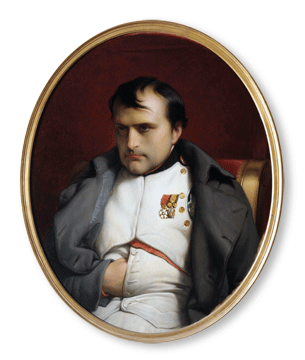
Born on the island of Corsica on August 15, 1769, Napoleone Buonaparte was one of eight children. His parents, Carlo and Letizia Buonaparte, were minor Italian nobles. When France purchased Corsica from Italy, Carlo became a French citizen and arranged for a French education for his children. At age nine, Napoléon entered an elite military academy. There he excelled in math and history but was teased because of his accent and small stature. His math skills enabled him to study artillery at the École Militaire in Paris. When he graduated, he joined the French army as a second lieutenant. He was 16.
Napoléon supported the French Revolution when it began in 1789, and his military training served him well. In 1793, Napoléon— by then a captain—was put in charge of the artillery during a siege to reclaim the captured city of Toulon. He devised a clever plan for taking the city’s forts and bombarding the enemy fleet anchored in the harbor. His success as a strategist earned Napoléon a promotion to brigadier general and leadership of the Army of Italy.
Over the next three years, as France endured serious political upheaval, Napoléon continued to rise in the army. He also married Marie- Josèphe-Rose de Beauharnais, whom he called Josephine.
Shortly after marrying Josephine, Napoléon began his conquest of Europe. His victories made him famous and popular, and the spoils of war (land, money, and other resources) greatly benefited
France’s struggling economy.
When Napoléon was ordered to attack Great Britain, France’s longtime foe, he instead proposed establishing a colony in Egypt to challenge British trade in that region. The Egyptian Campaign, which began in 1798, was a military disaster, but it did result in the recording of invaluable information about a poorly known part of the world.
Napoléon left his army in Egypt and returned to France, where he found widespread turmoil, poverty and corruption. He joined a plot to overthrow the government, and the coup was successful. In 1799, after Napoléon was elected First Consul of a three-member Consulate, he declared that the French Revolution was over. Three years later, a new constitution made him First Consul for Life, and in 1804, another constitution established an imperial monarchy with power vested in an emperor. Napoléon was asked by the French senate to fill that role.
As Napoléon was ascending to the highest levels of power, he continued to pursue military victories. He also worked to make France’s government and economy more stable. His long-term efforts to restore order and improve conditions resulted in some of his most meaningful, yet often overlooked legacies.
Although his “Grand Armée” had conquered most of continental Europe, Napoléon still had not subdued Great Britain, whose superior navy controlled the seas. After destroying the French fleet at the Battle of Trafalgar in 1805, Great Britain organized a coalition of allies in hopes of further victories. But Napoléon’s forces crushed these opponents. This yielded more land for France, more control of seaports and greater power for the emperor. After appointing relatives to head countries now controlled by France, he initiated an embargo on trade with Great Britain, in hopes of ruining its economy.
By 1810, Napoléon had reached the height of his power, but his fortunes were about to change. When Russia refused to honor the embargo, Napoléon launched an invasion. As the French forces pressed forward, the Russians fought but mostly retreated. When Napoléon reached Moscow, the city was empty; residents had fled, taking food and livestock with them and setting Moscow on fire. Faced with a bitter winter, no local provisions, and no chance of victory, Napoléon ordered his army to retreat.
Unfortunately, the weather, starvation, and emboldened Russian soldiers decimated the Grand Army as it withdrew. Of the 440,000 men who marched into Russia for the Emperor, only 30,000 returned. Napoléon’s enemies rejoiced. He was able to raise a new army, but it was outnumbered and outmaneuvered by his allied opponents, who ultimately captured Paris. In 1814, Napoléon abdicated and was exiled to the island of Elba, near Corsica, with the title of Emperor of Elba and a contingent of soldiers and staff. Louis XVIII, a member of the Bourbon dynasty overthrown by the Revolution, ascended to the throne.
Napoléon was not content merely to rule Elba. In 1815, he and 1,000 followers escaped by ship, landed on the French coast and marched toward Paris, picking up supporters along the way. Louis XVIII sent an army to stop him, but it joined him instead. With this force Napoléon took the capital and again assumed power. But Napoléon’s old enemies joined forces again and soundly defeated him at the Battle of Waterloo. He abdicated again, after ruling only 100 days.
For his second exile, Napoléon was sent farther away, to the Britishheld island of St. Helena, off Africa in the south Atlantic. He and his small staff lived there for nearly six years until the former emperor died on May 5, 1821.
KC Smith
Museum of Florida History
Back to top
Napoléon and Josephine’s Ill-fated Love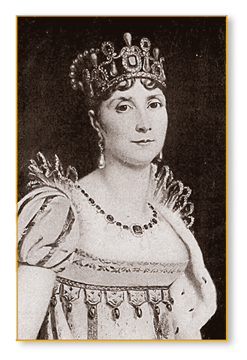
Letters written by Napoléon to his wife Josephine suggest that their love was deep and enduring. In fact, their relationship was bittersweet and often stormy. During their thirteen-year marriage, both were unfaithful, especially Josephine when her husband was away on military campaigns. When Napoléon learned of this, his love for her was crushed. When it became clear that Josephine could not produce a male heir, Napoléon ended their marriage in 1809. A year
later, he married Austrian Archduchess Marie Louise, who soon gave birth to a son named Napoléon, King of Rome.
Excerpts from Napoléon’s love letters to Josephine
“Sweet, incomparable Josephine, what a strange effect you have on my heart.” (1795)
“Oh, my adorable wife! I don't know what fate has in store for me, but if it keeps me apart from you any longer, it will be unbearable! My courage is not enough for that.” (1796)
“I have not spent a day without loving you; I have not spent a night without embracing you; I have not so much as drunk a single cup of tea without cursing the pride and ambition which force me to remain separated from the moving spirit of my life.” (1796)
Back to top
Words of Wisdom from the Famed Emperor
Although he is recognized primarily for his accomplishments as a soldier and statesman, Napoléon also is known for his many pithy observations about life. For example:
"A picture is worth a thousand words."
"A true man hates no one."
"Ability is nothing without opportunity."
"An army marches on its stomach."
"History is the version of past events that people have decided to agree upon."
"If you want a thing well done, do it yourself."
"Imagination rules the world."
"Impossible is a word to be found only in the dictionary of fools."
"In politics, stupidity is not a handicap."
"Never interrupt your enemy when he is making a mistake."
To discover more of Napoléon’s notable comments, go to:
http://www.brainyquote.com/quotes/authors/n/napoleon_bonaparte.html
Back to top
Napoléon's Contributions